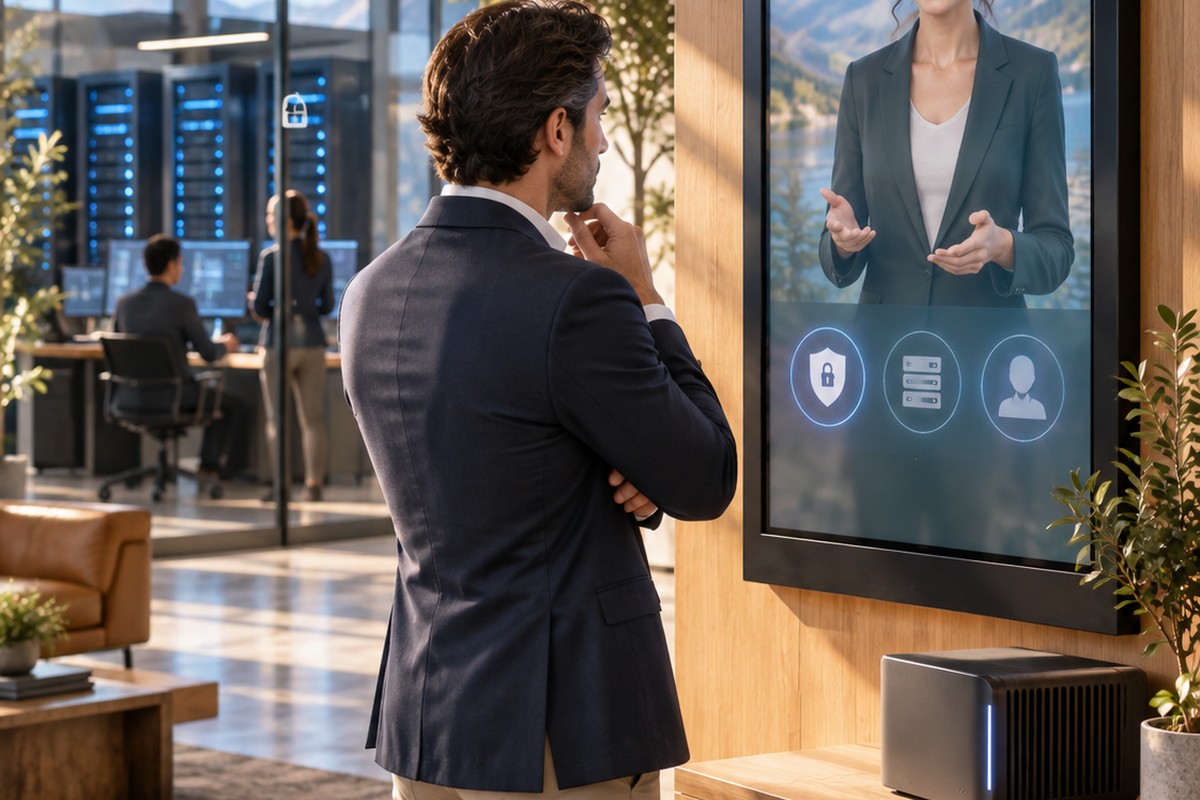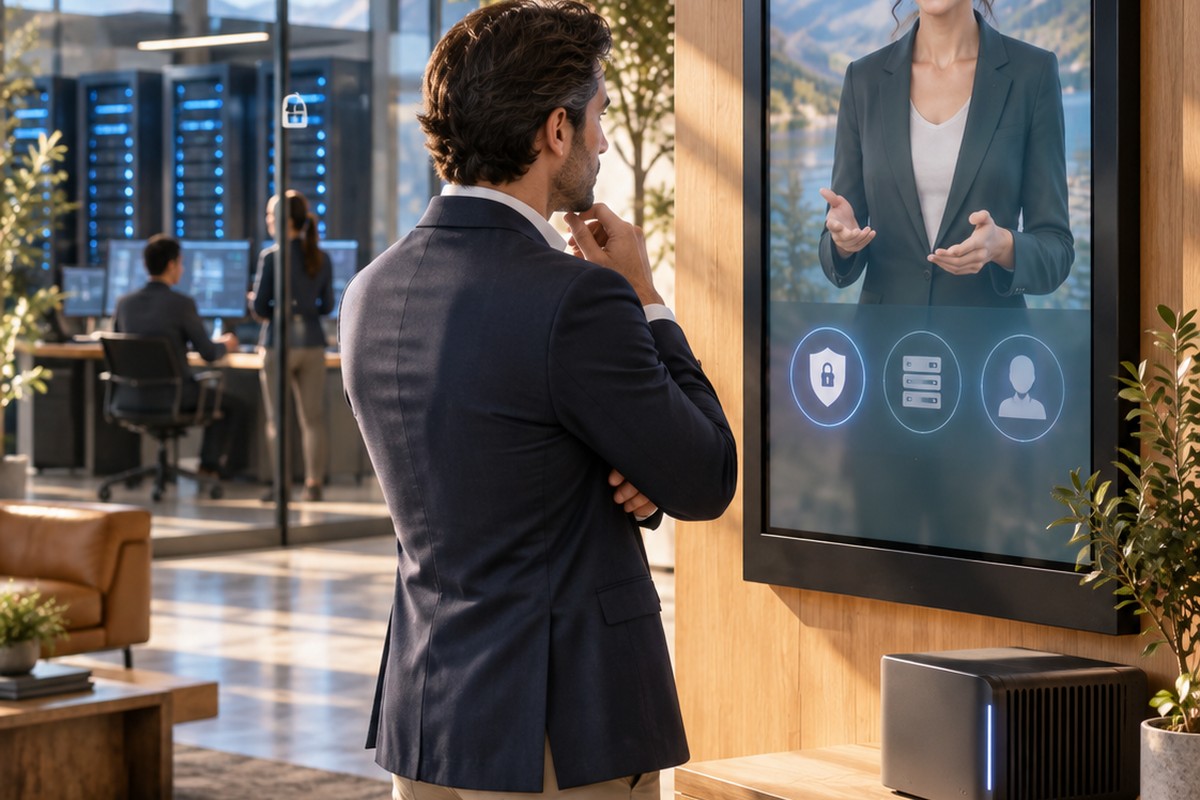
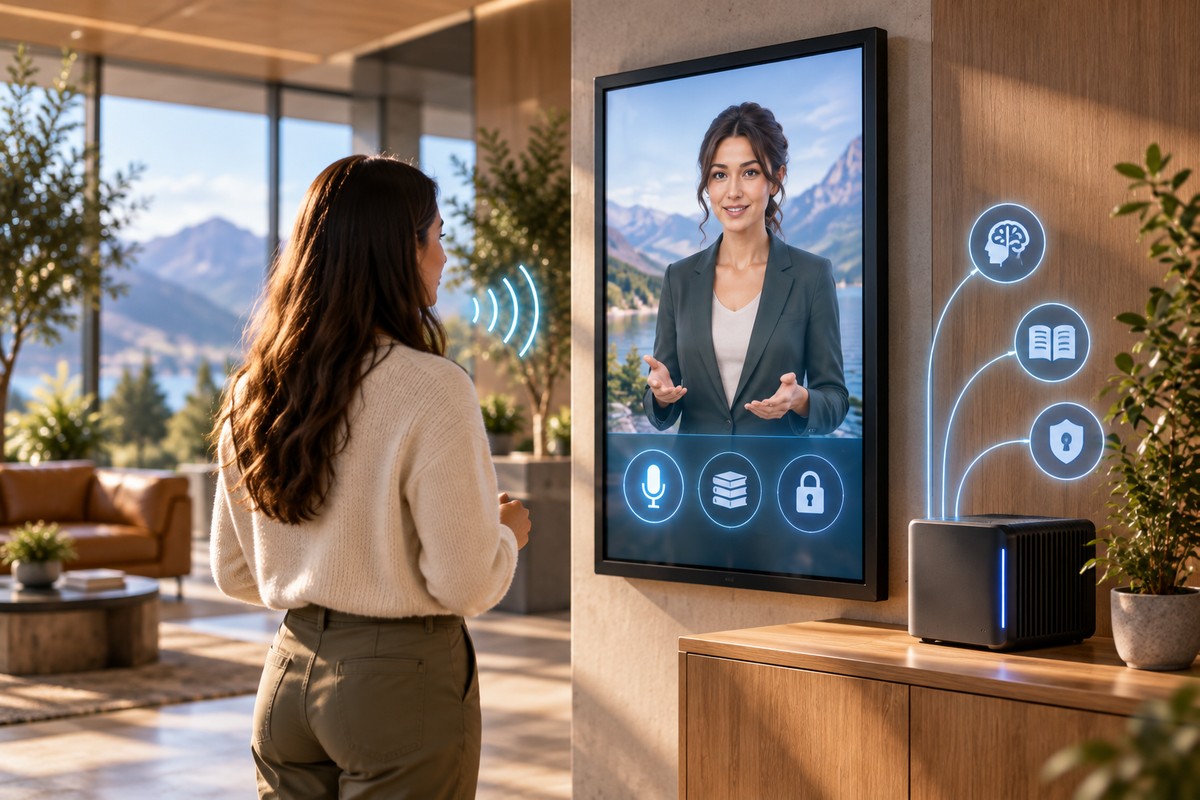
An offline AI avatar is a conversational digital character whose core runtime can operate on local hardware instead of sending every interaction to external cloud services. The user can speak or type, receive an answer, hear the response and see the avatar react even when the internet connection is unavailable.
That does not mean the system can never connect to the internet. Offline-first architecture separates the core conversation from optional connected features. The avatar can keep doing its main job locally while a connection is used only when it adds something useful, such as bookings, live information, links or software updates.
The local conversation pipeline
A complete offline avatar usually needs several components working together on the same machine or local network. First, speech recognition converts the user's voice into text, unless they type instead. A conversation or intent layer decides what the person is asking. The system then retrieves the relevant approved knowledge and creates a response. Text-to-speech turns the answer into audio, while the avatar player drives mouth movement, facial expression and other animation.
The important point is that each of these steps can be provided by local models and local software. When that is the chosen deployment, the core conversation does not need to call an external AI API every time someone asks a question.
Where does the knowledge live?
For a business deployment, the avatar should not rely on an uncontrolled mixture of public information. Its useful knowledge normally comes from material selected by the organisation: website pages, FAQs, product documents, museum records, policies, manuals, training content or other approved sources.
In a local deployment, that prepared knowledge can also remain on the local machine or local network. This gives the organisation a clearer boundary around what the avatar knows and where its operational data is stored.
What hardware is required?
Hardware depends on the realism of the avatar, the size of the local language and speech models, the response-speed target and the number of people using the system at once. A simple local assistant may run on relatively modest hardware, while some high-quality real-time digital humans are built around a dedicated GPU and more memory. VoxaGuide avatars are designed to run in the browser instead: mid-range phones and laptops run them comfortably, and kiosks don't need expensive GPU systems.
For a kiosk, the deployment should be sized for the actual workload rather than simply choosing the largest model available. Reliable response time, thermals, power consumption, maintenance and physical installation all matter.
What still benefits from an internet connection?
Local operation and internet connectivity are not opposites. A well-designed offline-first system can use the network selectively. A museum might connect for live ticket availability. A visitor centre might open current travel information. A commercial kiosk might issue a voucher or link to a booking service. The software itself can also receive approved updates when connected.
If the connection disappears, the local conversation can continue, while only the features that genuinely require live external data become unavailable.
Why choose offline or local operation?
There are several practical reasons. Some venues have unreliable connectivity. Some organisations want predictable operating costs instead of usage-based AI charges. Others want tighter control over where their approved knowledge and conversation services run. Kiosks may also need to continue working during an outage.
Local deployment can support those goals, but it does not remove the need for security, maintenance, backups, access control and good data governance. 'Offline' should describe the architecture, not be treated as a guarantee of privacy or compliance by itself.
What are the trade-offs?
Cloud platforms can offer enormous models, rapid central updates and elastic capacity. Local systems have finite hardware and need a planned update process. The engineering challenge is therefore to choose models that are capable enough for the job while remaining fast and reliable on the target machine.
For a focused business avatar, that can be a sensible trade. A character that answers from a bounded set of approved information may not need a giant general-purpose model to be useful.
Frequently asked questions
Does offline AI mean there is no internet connection at all?
Not necessarily. It means the core experience can operate without depending on the internet. Optional online services can still be added where they create value.
Can speech recognition and text-to-speech run locally?
Yes. Both speech recognition and voice synthesis can be provided by local models, provided the hardware and software are selected for the required quality and speed.
Are there still running costs?
Yes. Local systems still have hardware, electricity, maintenance, support and update costs. The difference is that a fully local conversation does not require a usage-based external AI API call for every question.
Can an offline avatar be updated?
Yes. Updates can be installed manually or delivered when the system is temporarily connected, depending on the deployment design and security requirements.
Turn this idea into your own avatar.
Tell us who your avatar should help, what it needs to know and where it will appear. We will discuss a focused first deployment around that job.
Discuss your avatar