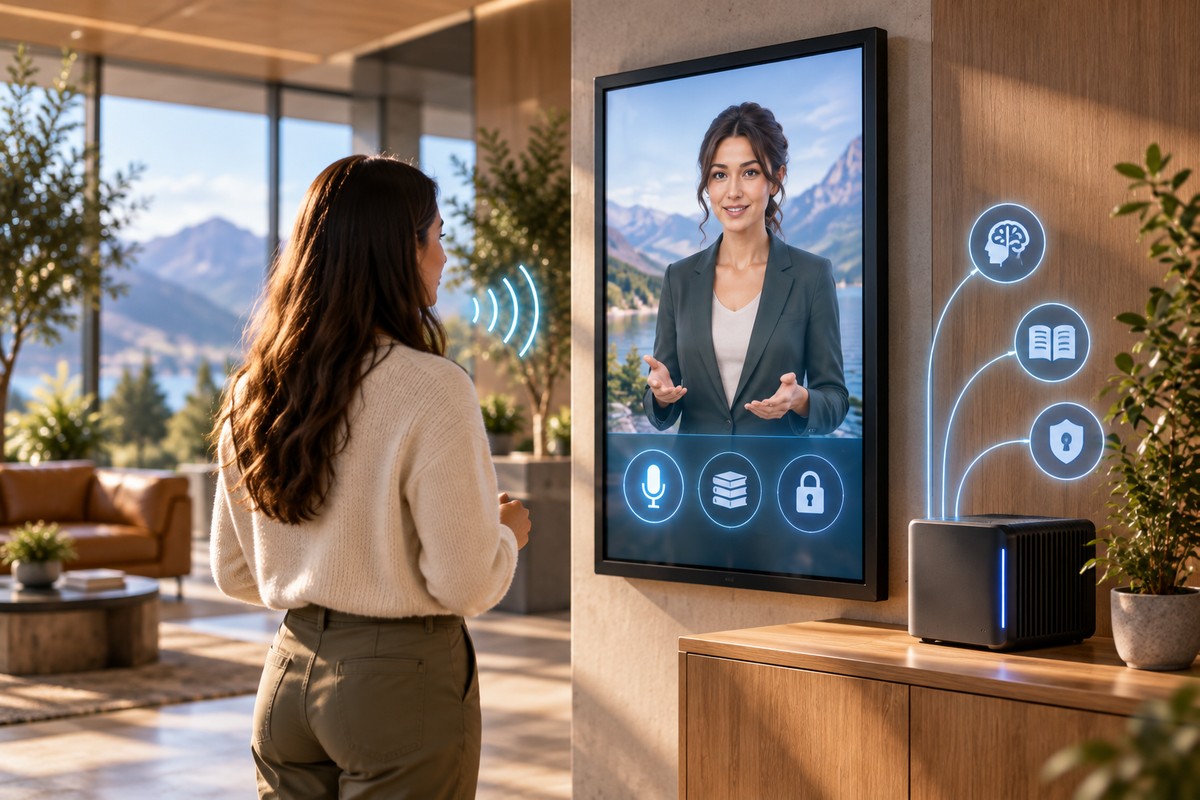

Yes. An AI avatar can work without the internet if the software needed for its core conversation is installed on local hardware. That means speech recognition, conversational processing, approved knowledge, text-to-speech and the visual avatar can all operate without sending each question to an external cloud API.
The key phrase is core conversation. A local avatar can still be connected when useful. Internet access might provide live bookings, current venue information, external links, offers or software updates, while the main question-and-answer experience remains available if the connection disappears.
Why do many AI avatars normally need the internet?
Many commercial AI services are delivered from remote data centres. The local website or kiosk records the user's speech or text, sends it to a provider, receives a result and then uses another service to create the spoken or visual response.
That approach can be convenient, especially for general-purpose applications, but it creates a dependency on connectivity and on the external services involved. If one of those services is unavailable, rate-limited or no longer authorised, part of the experience may stop working.
What has to run locally?
For a genuinely offline conversation, every required step needs a local equivalent. The microphone audio must be converted into text locally. The system must understand the request and locate an answer locally. The reply must be converted into speech locally. The avatar renderer must also run on the device or local network.
The knowledge itself should be stored locally too if the organisation wants the complete information path to remain on-site. This is particularly useful for installations that use a bounded set of approved documents rather than broad public web search.
What can still be connected?
A local avatar does not have to be isolated forever. Optional internet services can be layered on top. A museum guide might link to ticketing. A training avatar might retrieve a current external policy only when authorised. A visitor kiosk might show live transport information or generate a QR link.
The architecture should make the distinction visible: if the internet disappears, the user should still be able to use the core knowledge and understand which live features are temporarily unavailable.
Is the experience as capable offline?
That depends on the hardware and the models chosen. Cloud providers can offer very large models and significant computing power. A local system must fit within the CPU, GPU memory, RAM, storage and power available at the deployment.
For a focused business use case, that limitation can be manageable because the avatar does not need to know everything. If its role is to explain one museum collection, one company's services or one training programme, a focused local system using approved information can be more useful than an unrestricted general assistant.
What about updates?
Offline operation does not mean the system can never be updated. Content and software can be updated manually, over a controlled local network or during approved internet connectivity.
For managed deployments, a common pattern is to let the avatar continue running locally while updates are delivered on a separate schedule. That keeps day-to-day operation independent from the update mechanism.
When is internet-free operation most useful?
Offline capability is particularly useful for public kiosks, exhibitions, remote sites, secure environments, demonstrations, private networks and locations with inconsistent connectivity. It can also be attractive where an organisation wants predictable operating costs and does not want a usage-based external AI fee attached to every conversation.
It is less important when the experience already depends on live web data for almost everything. A public website, for example, may be connected by definition, although the conversational backend can still be hosted privately if required.
Frequently asked questions
Does offline mean no cloud services at all?
For the core conversation, it can. Optional cloud or web services can still be enabled for selected features if the organisation wants them.
Will an offline avatar still speak naturally?
It can. Local text-to-speech systems can generate the voice, although quality and hardware requirements vary by model.
Can a local avatar store conversation history?
Yes, but whether it should do so is a policy decision. Logging, retention, consent and authorised access should be configured for the use case.
Does offline automatically mean secure?
No. Local systems still need operating-system security, access control, patching, backups and appropriate data handling. Offline architecture reduces some external dependencies but does not replace security practice.
Turn this idea into your own avatar.
Tell us who your avatar should help, what it needs to know and where it will appear. We will discuss a focused first deployment around that job.
Discuss your avatar