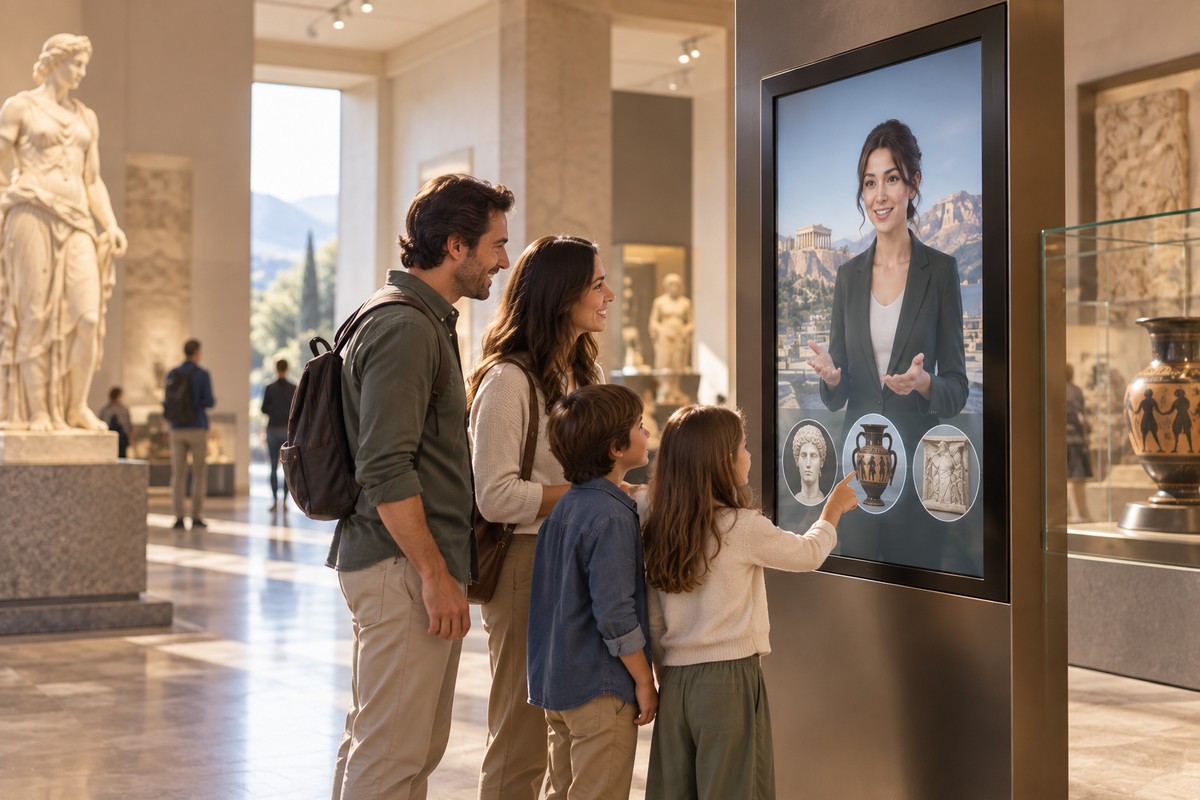
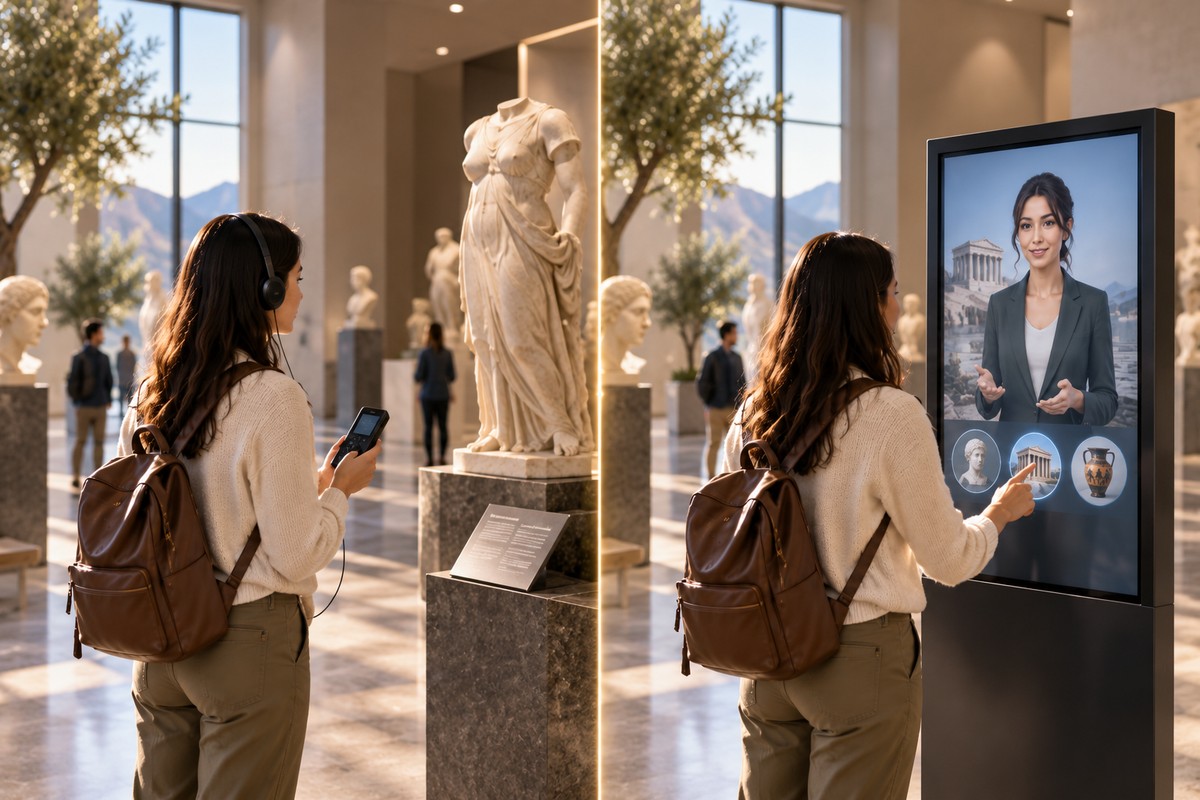
Traditional audio guides have served museums well for decades. They are familiar, predictable and effective at delivering a carefully produced tour. An AI museum guide solves a different problem: instead of asking every visitor to follow the same sequence, it lets people ask questions and choose their own route through the information.
The question is therefore not which technology is universally better. It is which experience fits the museum, its visitors and the type of interpretation being offered.
The core difference: linear content vs conversation
An audio guide is usually linear. A visitor selects a stop or track and hears a prepared recording. The museum knows exactly what will be said and how long it will take. That control is a major strength.
An AI museum guide is non-linear. The visitor can ask what they want to know, request more detail or change direction. The guide uses approved museum information to construct an answer for that interaction. This gives the visitor more freedom, but it also means the museum needs strong content boundaries, testing and a clear plan for how the guide should respond when information is missing.
Comparison at a glance
| Area | Traditional audio guide | AI museum guide |
|---|---|---|
| Experience | Prepared tracks or stops | Two-way questions and answers |
| Visitor route | Usually guided or numbered | Visitor-led and conversational |
| Content control | Exact recorded script | Approved knowledge plus response rules |
| Updates | Re-record and republish affected content | Update the approved knowledge and retest |
| Personalisation | Usually language or tour choice | Can adapt depth and route to questions |
| Connectivity | Often works fully offline | Can also run locally; connected features are optional |
| Best fit | Curated linear storytelling | Exploration, questions and visitor assistance |
Where audio guides remain strong
Audio guides are excellent when the museum wants a tightly authored narrative. A curator can control pacing, music, sound design, tone and exactly how the visitor encounters a story. They are also easy for visitors to understand and can be highly reliable once deployed.
For exhibitions where sequencing matters, a traditional audio tour may remain the right primary experience. An AI layer does not make good editorial storytelling obsolete.
Where AI guides add something different
AI guides become useful when visitors regularly have questions that a fixed track cannot anticipate. They can support object-level exploration, wayfinding, practical visitor information and different levels of explanation.
A family might ask for a simpler answer. A specialist visitor might ask for more detail. Someone who has joined halfway through can start with the object in front of them rather than searching for the correct track. This flexibility is the main reason to consider a conversational guide.
Content updates and governance
Audio-guide changes can require script editing, new recording, editing and redistribution. An AI guide can make some updates easier because the approved knowledge can be changed without re-recording every possible answer.
However, that does not remove editorial responsibility. Updated content still needs review, testing and clear rules about what the guide may say. Museums should treat the knowledge base and conversation rules as published interpretation, not as an ungoverned technical layer.
Accessibility and visitor choice
Neither format is automatically accessible. Audio guides can be paired with transcripts, captions and adapted tours. AI guides can support speech and text, but the kiosk, microphone, interface, screen height, captioning and interaction design all matter.
The best approach is often to provide multiple routes. A conversational guide can sit alongside labels, audio, BSL or signed content, printed material and staff support rather than forcing every visitor into one digital format.
Can a museum use both?
Yes. In many cases, a hybrid model is the most interesting option. A museum can keep a carefully authored audio tour for its main narrative and add an AI guide for follow-up questions, object discovery, directions and visitor information.
The technologies then serve different needs instead of competing for the same job.
Frequently asked questions
Will an AI guide replace an audio guide?
Not necessarily. A conversational guide and an audio tour can be used together because one is visitor-led and the other is deliberately authored and linear.
Can an AI guide work offline like an audio guide?
Yes, if the speech, knowledge and conversational components are installed locally. Connected services can remain optional.
Which is easier to update?
An AI guide can make factual knowledge updates faster because content can be changed without re-recording every answer, but museums still need a review and testing process before publishing those changes.
Turn this idea into your own avatar.
Tell us who your avatar should help, what it needs to know and where it will appear. We will discuss a focused first deployment around that job.
Discuss your avatar